

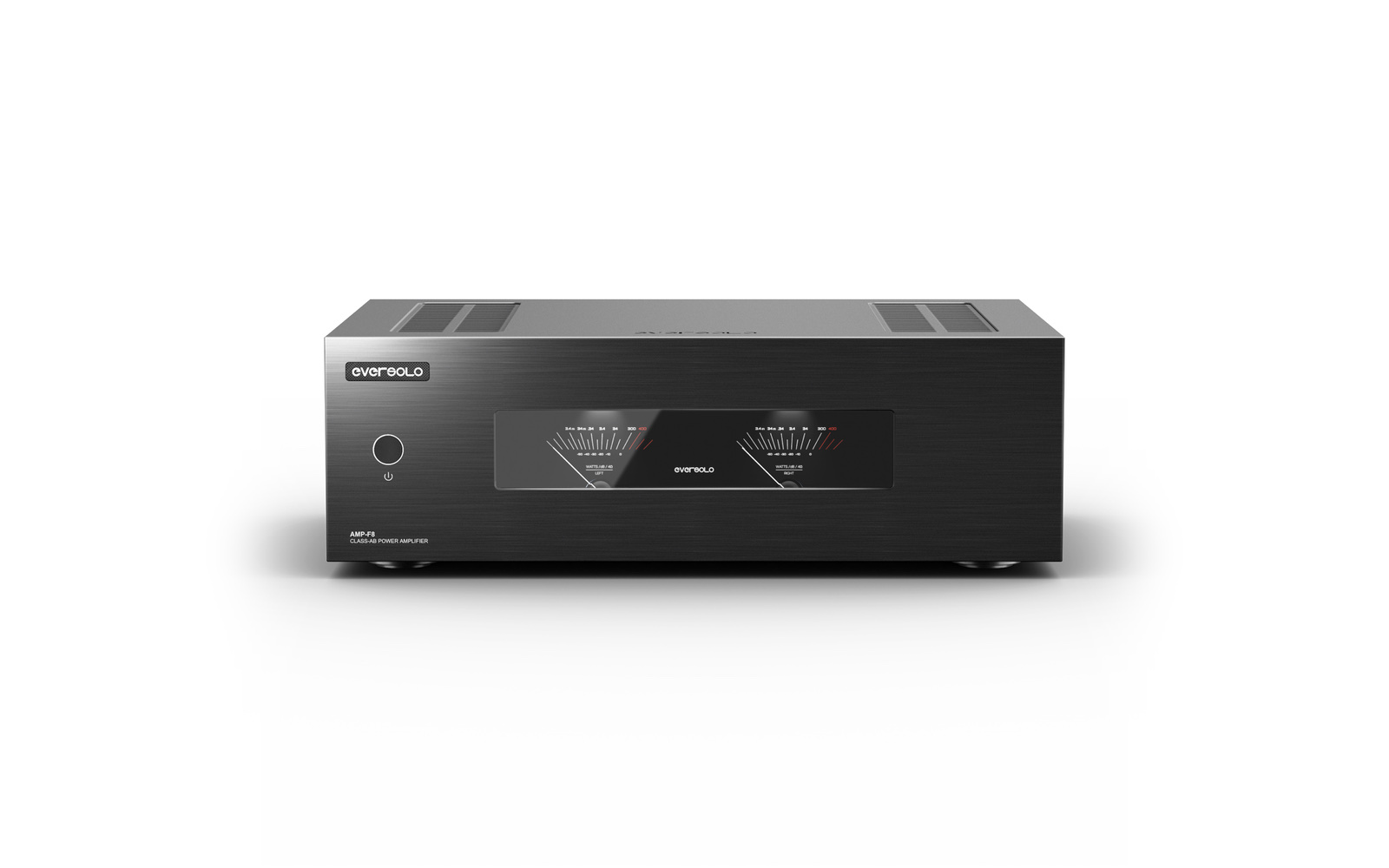


Eversolo AMP-F8, performance in class AB
Since its beginnings, Eversolo has been known for network players with touchscreens, DSP and room correction. The AMP-F8 goes the opposite way: no conversion, no network, no volume control. One 800 W ring core transformer, six MOSFET per channel, two inputs and two pairs of speaker terminals. It is the second power amplifier of the brand in class AB, in a more compact format than the first.

One device, two configurations
In stereo mode, the AMP-F8 delivers 180 W RMS per channel to 8 Ω and 280 W to 4 Ω. A switch on the back switches the two channels into bridge: the two stages then work counter-phase at a single output, and the power rises to 500 W RMS at 8 Ω. One copy is sufficient for a complete stereo system. Two copies, one per speaker, result in a pair of mono power amplifiers.
This step-by-step extension saves the sale of the amplifier when the speakers become more power-hungry one day or the room grows larger. Bridge operation has its flip side: each stage sees half the impedance presented by the loudspeakers, and Eversolo only mentions one value for 8 Ω in this configuration. For speakers that fall to 4 Ω or below, classic stereo operation remains a safer choice.
A power supply for peak performance
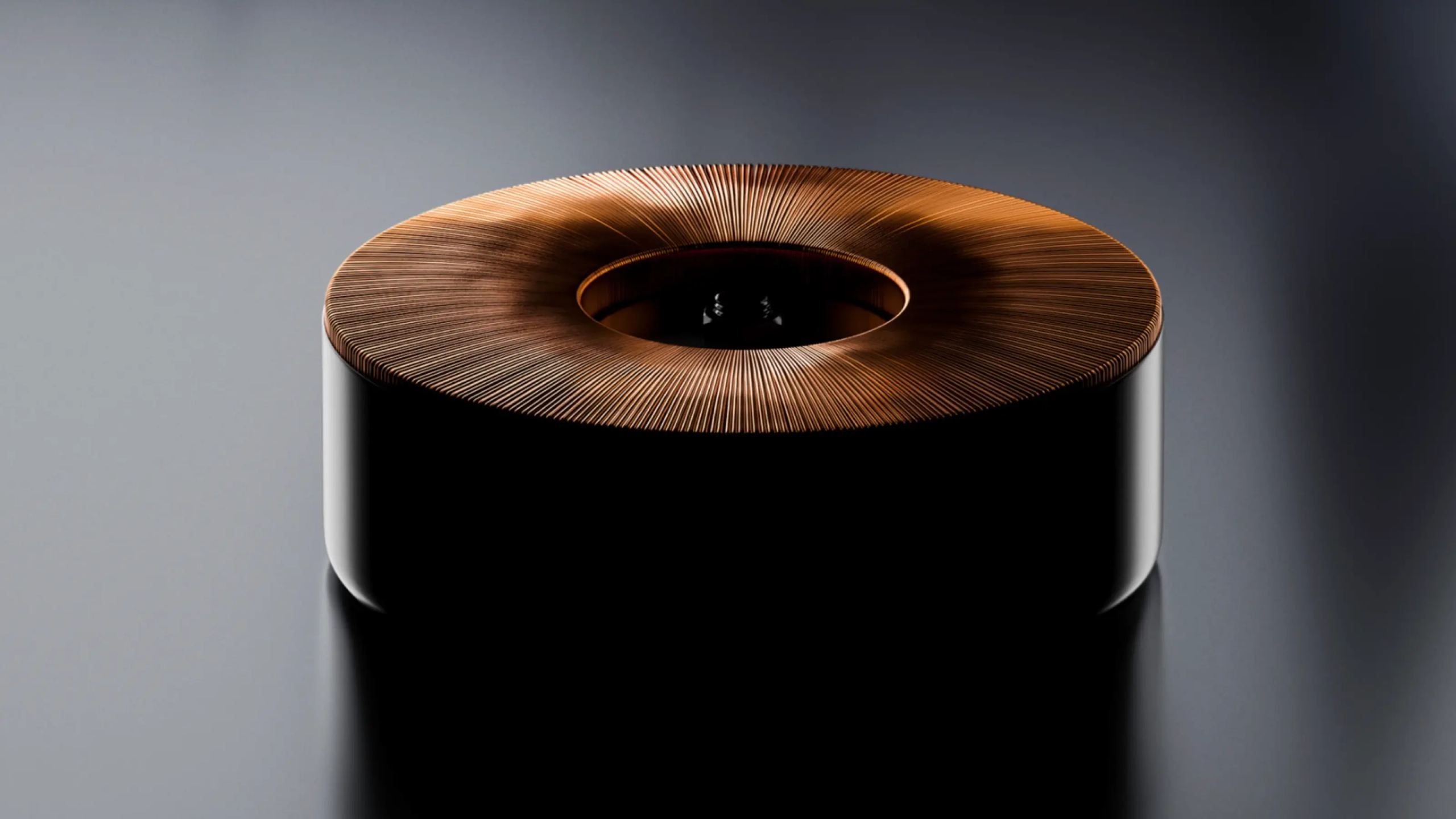
Designed specifically for this device, the 800 W ring core transformer has separate supply branches for each channel to limit interactions between channels. Twenty-four high-capacity audio capacitors complement it. Their task is double: they smooth the residual ripple of the rectified voltage and provide a power reserve that can be mobilized within a few milliseconds if a transient demands significantly more than the average power. Here, the difference is between an amplifier that maintains its stability in a bass drum attack and an amplifier that buckles.
A DC barrier circuit completes the whole. The mains voltage frequently contains a disturbing DC voltage component generated by household appliances which only absorb current during a half-wave. A torrental core is sensitive to this: it begins to vibrate mechanically, and the hum is audible from the piece of furniture, even when the loudspeakers are switched off. The filter removes this component before the primary winding.
Three MOSFET pairs per channel
The output stage is based on three high-current MOSFET pairs per channel, i.e. six power transistors on each side, which are connected in parallel to divide the current. Before that, the symmetrical differential circuit processes the signal in two opposite-phase branches, whereby a large part of the two common disturbances is eliminated, starting with those from the power supply. A precise negative feedback completes the work.
Eversolo specifies a distortion factor including noise of 0.003%, an A-rated signal-to-noise ratio of at least 115 dB, a frequency response of 10 Hz to 30 kHz at ±0.5 dB and a channel separation below -95 dB. The damping factor exceeds 400 at 8 Ω, which corresponds to an output impedance of less than 0.02 Ω: The amplifier counteracts the current that the voice coil of the woofer returns after a pulse, and the membrane stops abruptly. This number is to be relativized because it is measured on the terminals of the device: ten meters of 2.5 mm2 cables is enough to lower the actual damping to about 50.
Two inputs, two gain levels
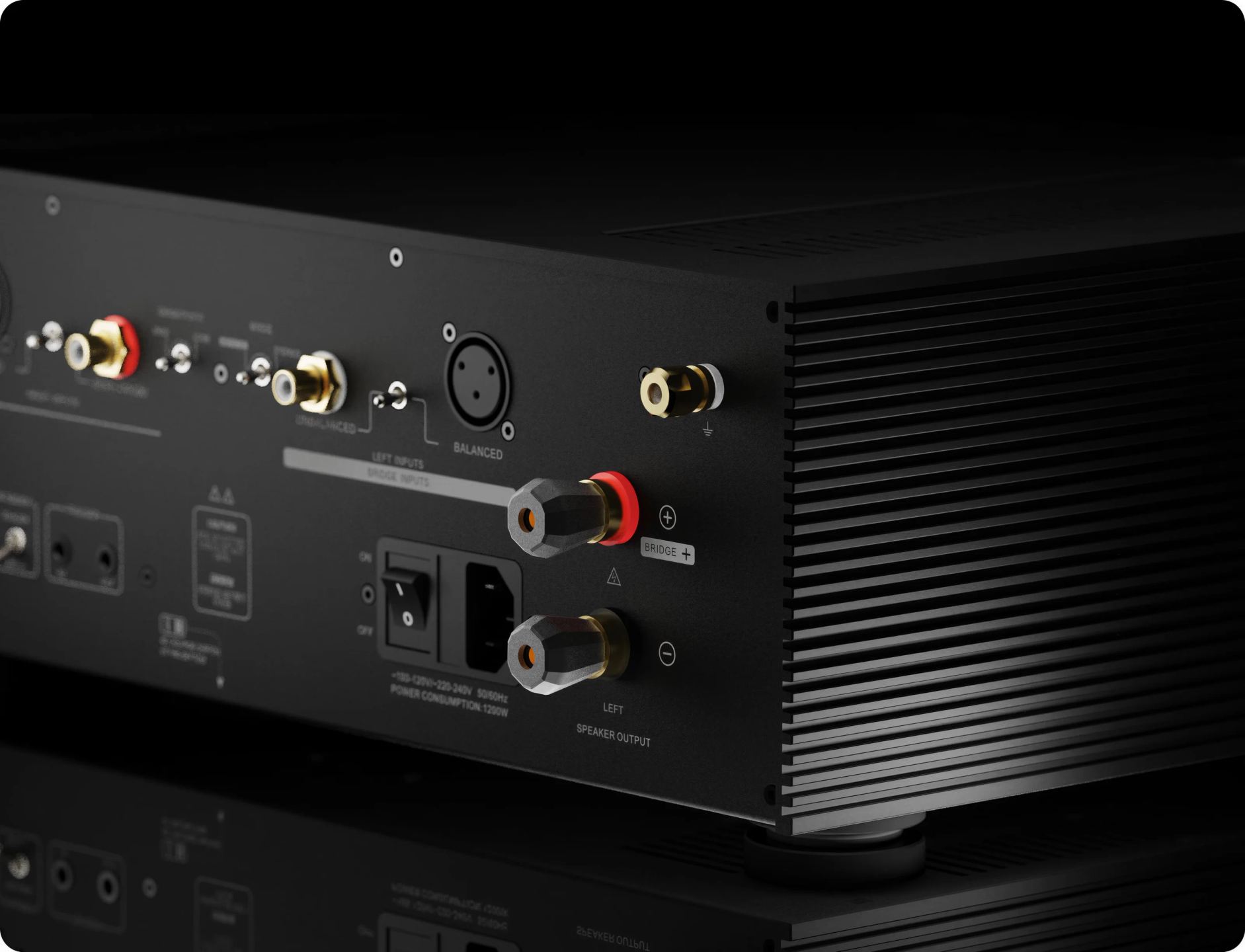
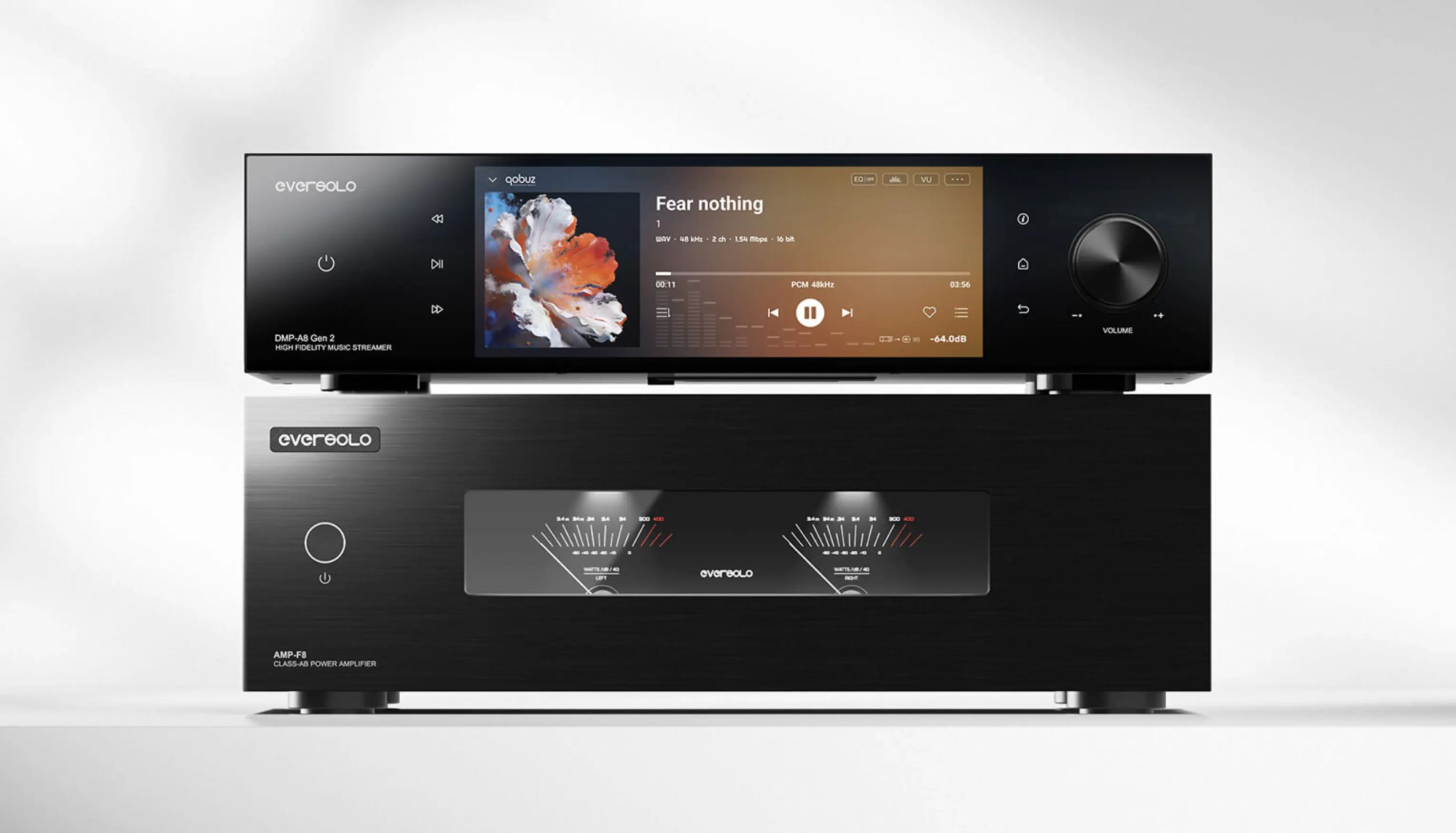
The connections are quickly listed: a symmetrical XLR input, an asymmetric RCA input, both with 10 kΩ, and a switch to select one or the other. No multi-source selector switch, no volume control. The AMP-F8 requires a preamp beforehand, a variable output converter or a network player that regulates the level.
The gain can be adjusted in two positions, 23 or 29 dB. At 23 dB, 5.2 V is required symmetrically or 2.65 V asymmetrically to achieve full power; at 29 dB, 2.6 V and 1.3 V are sufficient. The choice is not incidental. A high-voltage source should remain at 23 dB: the amplifier's ground noise is less evident, and the preampline's potentiometer continues to operate at the top of its control range, where channel equality is best. The 29 dB position compensates for low output levels sources. A 12V trigger at the input and output links turning on to the rest of the system, a standby switch and a lighting switch complete the back, and the clamps accept both fork shoes and banana plugs.
A milled housing and VU meter
The aluminum is CNC machined and obtains a sandblasted, anodized surface, with shielding against electromagnetic interference and heatsinks on the sides. The dimensions are unusual for this performance: 265 mm width, 388 mm depth, 119 mm height and 15.9 kg weight. The AMP-F8 requires less width than a device in a traditional format, but requires a sufficiently deep piece of furniture; two specimens next to each other require 53 cm shelf width.
At the front, two backlit analog VU meters show the level in real time, and their lighting can be turned off from the back when the pointers become disruptive during a movie. Class AB converts a significant part of the energy into heat, even in idling, and the specified maximum power consumption reaches 1200 W. The cooling is passive, without a fan: A closed piece of furniture should be avoided, better is a free storage area above and on the sides.
His position in the Eversolo range
Three power amplifiers are next to each other in the catalogue. The AMP-F2 in class D is based on a NS600 module developed together with Starke Sound and weighs only 3.65 kg. The AMP-F10 is the big brother in class AB, with a linear 1000 W power supply with two independent channels, five MOSFET pairs per channel, 200 W at 8 Ω, 320 W at 4 Ω and 650 W in bridge operation, at 18 kg and 430 mm width.
The AMP-F8 positions itself between the two, and not only in terms of performance. Its stated distortion of 0.003% is lower than the 0.008% of the larger model, while its damping factor is left behind with over 400 versus over 600. Eversolo also does not publish a value of 2 Ω for the AMP-F8, while the AMP-F10 claims 450 W per channel. These differences should be read with caution, as the measurement conditions are not always identical from data sheet to data sheet, but they draw two characters: the more compact model aims at fineness and lower space requirements, the greater on power delivery capability at difficult loads.
Technical characteristics
General information
- Type: Stereo Power Amplifier
- Amplifier technology: Class AB
Output power
- Stereo mode
- 180 W RMS per channel at 8 Ω
- 280 W RMS per channel at 4 Ω
- Bridge mode (bridge)
- 500 W RMS at 8 Ω
Audio performance
- Frequency response: 10 Hz – 30 kHz (±0.5 dB)
- Signal-to-noise ratio: ≥ 115 dB (A)
- Clinking factor + noise (THD+N): 0.003 %
- Attenuation factor: > 400
- Cross-talk: ≤ -95 dB
Amplifier architecture
- High Quality Class AB Reinforcement
- Symmetrical differential architecture
- Three high-current MOSFET pairs per channel
- Precision countercoupling
- Outstanding linearity over the entire operating range
Internal power supply
- Linear 800 W Ring Core Transformer
- Independent power supplies for each channel
- 24 high capacity audio capacitors
- DC blocking circuit (DC blocker)
- Reduction of vibrations and electrical interference
Sound quality
- Original reproduction of the recording
- Very low basic noise
- Outstanding channel separation
- Stronger, fast and perfectly controlled bass
- Large dynamic reserve
- Precise stereo stage
- Natural and detailed timbres
Connectors
- Audio inputs
- 1 × Symmetric XLR
- 1 × Unbalanced RCA
- Entrance impedance
- XLR: 10 kΩ
- RCA: 10 kΩ
- XLR input sensitivity
- 5.2 V (reinforcement 23 dB)
- 2.6 V (amplification 29 dB)
- RCA input sensitivity
- 2.65 V (amplification 23 dB)
- 1.3 V (amplification 29 dB)
- High quality speaker connectors
Construction and housing
- CNC machined aluminum housing
- Sandblasted anodized surface
- Shielding against electromagnetic interference
- Optimized heat dissipation
- Illuminated analog VU meters on the front
Compatibility
- Hi-Fi preamp
- DACs with volume control
- Network Player
- Stereo Hi-Fi systems
- Compact and floorstanding speakers
- Powerful mono installation thanks to bridge mode
Power supply
- Supply voltages: 100 to 120 V / 60 Hz, 220 to 240 V / 50 Hz
- Maximum power consumption: 1200 W
Dimensions and Weight
- Dimensions (W × T × H): 265 × 388 × 119 mm
- Net weight: 15.9 kg
- Gross weight: 18.6 kg
Included accessories
- Power cord
- Trigger cable
- Operating instructions